Receive FREE Reflections from the Editors of the SCI by EMail



November's topsy-turvy stock market and economic outlook are making investors nervous.

If you spend enough time following financial news, you might conclude that Wall Street economists possess a crystal ball with a cracked lens. On any given afternoon, one market strategist insists the American expansion is invincible, while the next guest warns that an economic downturn is practically knocking at the door.
Whenever storm clouds gather over the U.S. economy, conventional Wall Street wisdom tells individual investors to flee small-company stocks and hide in "safer" mega-cap giants. At the SmallCap Informer, we prefer to look at the actual historical record rather than build portfolios around macroeconomic guesswork or market clichés.
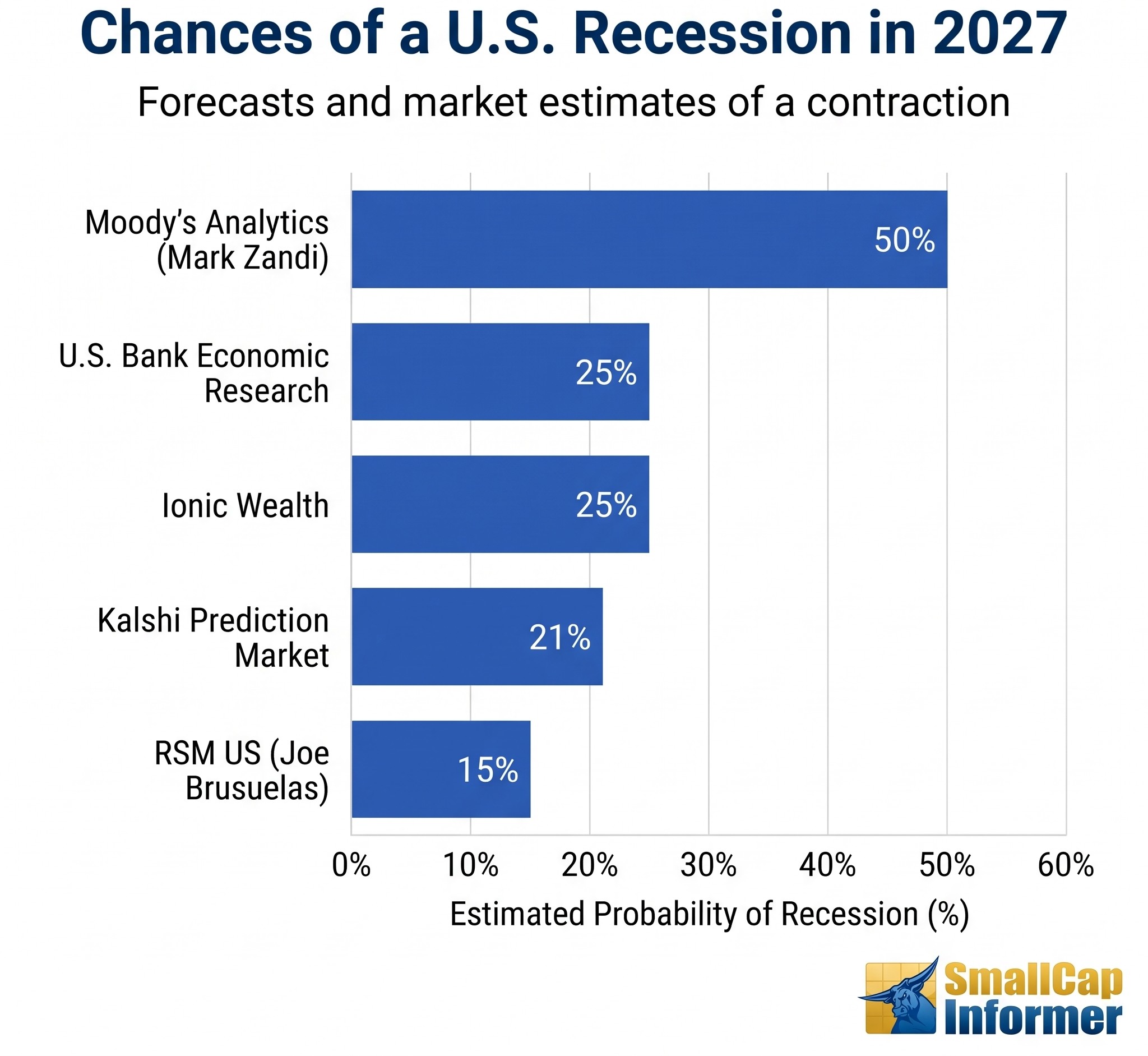
Right now, the consensus on Wall Street still leans toward continued economic expansion heading into 2027. Still, a growing chorus of economists has begun flagging heightened vulnerabilities. Leading the naysayers has been Moody’s Analytics Chief Economist Mark Zandi, who in November 2026 commentary placed the odds of a U.S. recession over the next two years at roughly 50%, or "about even," a figure substantially above historical norms. Zandi pointed to a convergence of headwinds, including tariffs, restrictive immigration policies, inflationary spillovers from the Iran conflict, and potential shocks ranging from "the bursting of an AI-driven financial market bubble to cyberattacks, terrorism and rapid job losses."
Other voices have echoed that caution, even while keeping an outright contraction out of their official baseline projections. In its November 2026 economic outlook, U.S. Bank's Economic Research Group pegged the 12-month probability of a U.S. recession at 25%, citing sticky inflation, elevated borrowing costs, and an economy increasingly reliant on financial-market wealth and heavy AI infrastructure spending.
On a similar note, EY-Parthenon Chief Economist Gregory Daco observed in November 2026 that "a recession is not our base case, but the economy is on a narrower path than it was," noting that "elevated prices, high borrowing costs and softer income growth leave households and businesses increasingly sensitive to adverse shocks."
Academic and wealth-management observers alike have raised similar flags about the fragility of the current market. Duke University Research Professor of Economics and former senior Federal Reserve adviser Ellen Meade noted that while modest additional rate adjustments by the Federal Reserve should not single-handedly tip the economy into a downturn, underlying imbalances mean a recession is not impossible to imagine, particularly if geopolitical conflicts escalate or financial markets suffer a sharp AI- or crypto-led sell-off.
And Ionic Wealth warned in a recent research assessment that near-term contraction odds sit at 25%, alongside a 75% probability of market-panic volatility. They pointed out that real wages, equity wealth, and home equity were declining simultaneously during the fourth quarter. Even Goldman Sachs Research, under Chief Economist Jan Hatzius, noted that while global growth appears steady into 2027, macroeconomic risks remain tilted to the downside, keeping U.S. recession probabilities above pre-war baselines.
To be sure, plenty of sober-minded analysts see a more resilient picture. Economists such as Gus Faucher at PNC and Kathy Bostjancic at Nationwide wrote in mid-month that they do not anticipate a recession over the next two years, pointing to steady spending by higher-income consumers, a sturdy labor market, and "continued buoyant productivity growth that would underpin economic activity overall."
The Federal Reserve’s own October 2026 FOMC minutes noted that Fed staff actually nudged their near-term economic activity outlook slightly higher based on incoming data, while traders on the Kalshi prediction exchange priced the odds of a U.S. recession before year-end 2026 at just 2% and placed the probability of a contraction during 2027 at 21%.
Suppose the pessimists prove prescient and the U.S. economy does slip into a contraction. Does that mean small-cap investors are doomed to suffer worse losses than large-cap shareholders?
Since its launch in October 1994, the S&P SmallCap 600 has navigated three official National Bureau of Economic Research recessions, and the data reveals a surprisingly encouraging story.
Because stock markets are forward-looking discounting mechanisms, smaller companies typically sell off well before a recession is officially declared and begin recovering months before economic output hits bottom. Measured across the official peak-to-trough recession windows, the S&P SmallCap 600 actually outperformed the large-cap S&P 500 in two of the last three U.S. downturns.
During the 2001 recession triggered by the dot-com bust and the September 11 attacks, the S&P SmallCap 600 gained 6.8% while the S&P 500 slipped 0.9%. In the severe 2007–2009 Global Financial Crisis, both indexes suffered steep declines, yet the S&P SmallCap 600 lost 30.6% across the official recession window compared to a 35.0% drop for the S&P 500, and small-caps went on to lead the market off the March 2009 bottom. Only during the brief, two-month COVID-19 pandemic shock in early 2020 did the S&P SmallCap 600 lag, falling 12.5% against a 1.1% dip for the S&P 500, before roaring back with gains exceeding 100% over the next twelve months.
The secret behind the S&P SmallCap 600's historical staying power lies in good part in its profitability requirements. Unlike the unscreened Russell 2000 Index, which includes hundreds of money-losing, speculative businesses, S&P requires prospective S&P 600 companies to post positive GAAP earnings both in the most recent quarter and over the sum of the trailing four quarters. As S&P Dow Jones Indices explains, "the profitability screen has been a key driver of the S&P 600's long-term outperformance over the Russell 2000, imbuing the index with a quality tilt that has historically helped cushion drawdowns during periods of market stress." When credit tightens and borrowing costs rise during a downturn, profitable businesses with real cash flows survive and take market share while cash-burning competitors falter.
Of course, sector selection still matters when GDP contracts. Because S&P 600 companies generate the vast majority of their revenues inside the United States, they are often insulated from foreign currency swings and global trade disputes, yet they remain closely tied to domestic consumer spending and regional commercial lending. Sector research on business-cycle performance by State Street Global Advisors demonstrates that defensive sectors providing everyday necessities (specifically Consumer Staples, Utilities, and Healthcare) have historically outperformed the broader market in roughly 88% of recessionary periods. Within the S&P 600, the Healthcare sector enjoys a particular advantage over the Russell 2000 because the index's earnings screen filters out speculative, pre-revenue biotechs in favor of established medical device makers, specialty distributors, and outpatient care providers.
On the other side, rate-sensitive and economically cyclical industries bear the brunt of contractions. Real Estate and Industrials have trailed the broader market in 87% of recessionary periods, while Information Technology has lagged in 62% of contractions as corporate buyers freeze capital expenditures and hardware orders.
CME Group Economic Research observed in its analysis Are U.S. Small Caps Undervalued Relative to Larger S&P 500 Peers? that "small-cap indexes carry substantially higher weights in regional banks, industrials, and consumer discretionary companies than the tech-heavy S&P 500, making their earnings far more sensitive to domestic interest rates and credit conditions." When the yield curve inverts or commercial loan defaults tick upward, small regional banks and heavily leveraged real estate operators feel the pinch immediately.
Even so, the nimble operational structure of well-run small companies will often convert an economic downturn into a springboard for future gains. Without layers of corporate bureaucracy or sprawling international supply chains, focused small-cap management teams can adjust pricing, trim overhead, and recalibrate inventory much faster than sprawling conglomerates once demand stabilizes.
As William Blair Investment Management highlighted in its 2026 report Economics Weekly: The Small-Cap Rotation, "small-cap earnings historically enter an earnings recession earlier than large caps, but they also inflect upward sooner, allowing smaller companies to capture the strongest relative gains during late-recession troughs and the first year of economic recovery."
For SmallCap Informer subscribers, the takeaway from this macroeconomic tug-of-war is clear and reassuring. Whether the economy cruises toward a soft landing or stumbles along a "narrower path" into recession, our job is not to guess which economist will win the debate. Instead, we focus on owning profitable, well-capitalized companies with manageable debt loads, durable competitive niches, and sensible valuations—the exact qualities at the heart of our selection process.
If the optimists are right, quality small companies will continue compounding earnings; if the pessimists prove prescient, financially sound businesses are built to weather the storm and lead the recovery that inevitably follows.
For a regular stream of high-quality small companies that often form the basis of a sound all-weather portfolio, subscribe to the SmallCap Informer today.
Stay the course!
— DOUG GERLACH
Subscribers can read Doug's monthly commentary and the in-depth profile of our recommended small company stock in each issue of the SmallCap Informer stock newsletter. Not a subscriber? Subscribe to the SmallCap Informer and get monthly small company stock recommendations and updated buy/sell prices for each of the ~40 high-quality small company stocks currently covered in the newsletter.
©Equity Research Service. All Rights Reserved. Privacy Policy. Terms of Use.